
How Generative Music Works — And Why It's Not Cheating
A clear-eyed look at what generative music actually is, how it differs from AI composition, and why using it is a legitimate creative choice.
The producer's role in generative music isn't eliminated — it's redirected toward curation, taste, and the decisions that actually shape how a track feels.
Every time a new music-making tool gets traction, someone calls it cheating. Drum machines were going to replace drummers. Samplers were going to make musicians redundant. DAWs were going to turn everyone into a producer overnight. None of these things happened — the tools changed, and music kept getting made.
Generative music is getting the same treatment. The concern is understandable. If an algorithm is producing the notes, what exactly is the human doing? It's worth answering that question directly.
What Generative Music Actually Is
Generative music uses algorithms — sets of rules — to produce musical output. The rules might govern which pitches are allowed, how dense the rhythm should be, how far apart consecutive notes can be, or how a melody relates to an underlying chord sequence. Within those rules, randomness or probability determines the specific output each time.
The result is music that sounds different on every listen, but that always sounds coherent — because the rules ensure it stays within a defined musical space. You set the space; the algorithm explores it.
This is different from AI music generation, which trains on existing recordings and learns to predict what comes next based on patterns in the data. Generative music doesn't learn from data — it follows rules you define.
Music Has Always Been Built on Systems
The idea that music should emerge purely from inspiration, unmediated by rules or processes, is a romantic myth. Every style of music is defined by constraints: the notes available in a scale, the rhythms typical of a genre, the chord progressions that make sense harmonically.
Classical composers worked within strict formal structures — sonata form, fugue, theme and variations — that dictated how music should develop across a piece. Jazz musicians improvise within a chord chart and a set of accepted scales. Electronic producers build tracks from loops, which are — by definition — a repeating algorithmic pattern.
Generative music makes the system explicit and hands you control over it. That's not a departure from how music has always been made. It's a more transparent version of the same thing.
What the Producer Actually Does
When you use a generative tool, you don't stop making decisions — you make different decisions. Instead of choosing individual notes, you choose the parameters that shape the space those notes come from. You pick the key, the scale, the rhythm density, the melodic character. You choose which instruments to use and how they interact. You decide when the music should change and how.
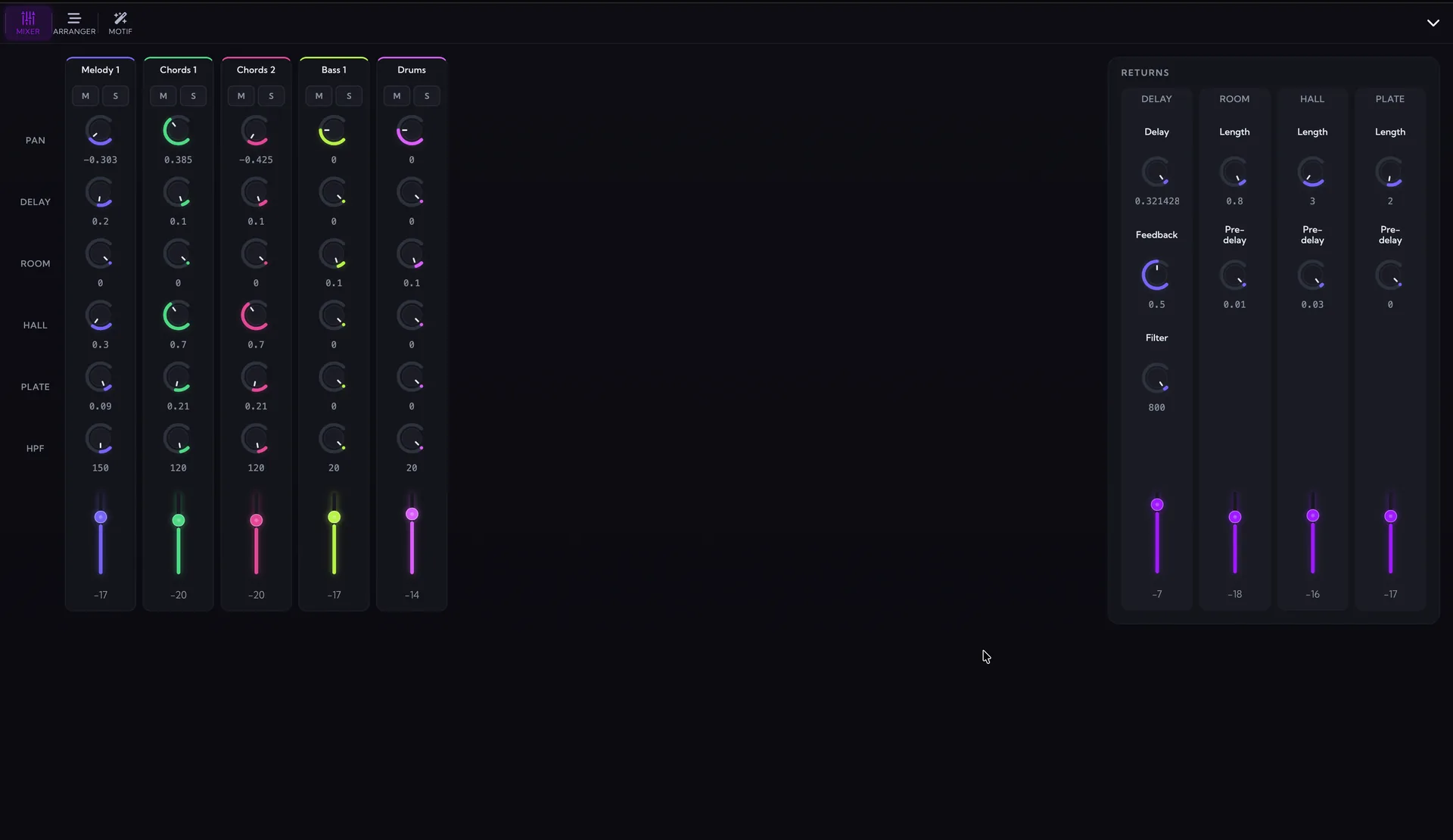
And then — critically — you listen. You hear what the algorithm produces and you judge it. Does this feel right? Is this the energy I want in this section? Should the melody be sparser, or denser? That act of listening and evaluating is taste, and no algorithm has it.
The producer using a generative tool is acting as a curator and a director: setting up conditions, listening to outputs, and making judgements about what serves the music. That's creative work. The fact that it happens at a different level of abstraction than note-by-note composition doesn't make it less so.
Why It Expands Creativity Rather Than Replacing It
The most common outcome when producers start using generative tools isn't that they stop making creative decisions — it's that they make more of them, faster. A generative system can explore far more musical territory in an hour than a producer manually inputting notes can cover in a week. That means more ideas to react to, more possibilities to evaluate, more directions to explore.
Many producers also find that generative music produces ideas they wouldn't have arrived at on their own — note combinations, rhythmic patterns, or harmonic relationships that fall outside their habitual vocabulary. Reacting to those surprises, keeping what works and redirecting what doesn't, is a genuinely creative act.
The question isn't whether generative music is cheating. The question is whether the music is good. If it is, the process that produced it is beside the point. Try it for yourself and see what you come up with.